
Silk Road Guide: Samarkand, Bukhara & Khiva
Categories
Tags
Uzbekistan is the heart of the Silk Road, home to three UNESCO-listed city centres — Samarkand, Bukhara, and Khiva — where turquoise domes, mosaic madrasas, and ancient bazaars transport you across centuries of Timurid and Islamic history. Visit in spring or autumn, ride the Afrosiyob high-speed train between cities, and expect warm hospitality at remarkably affordable prices.
Silk Road Guide: Samarkand, Bukhara & Khiva
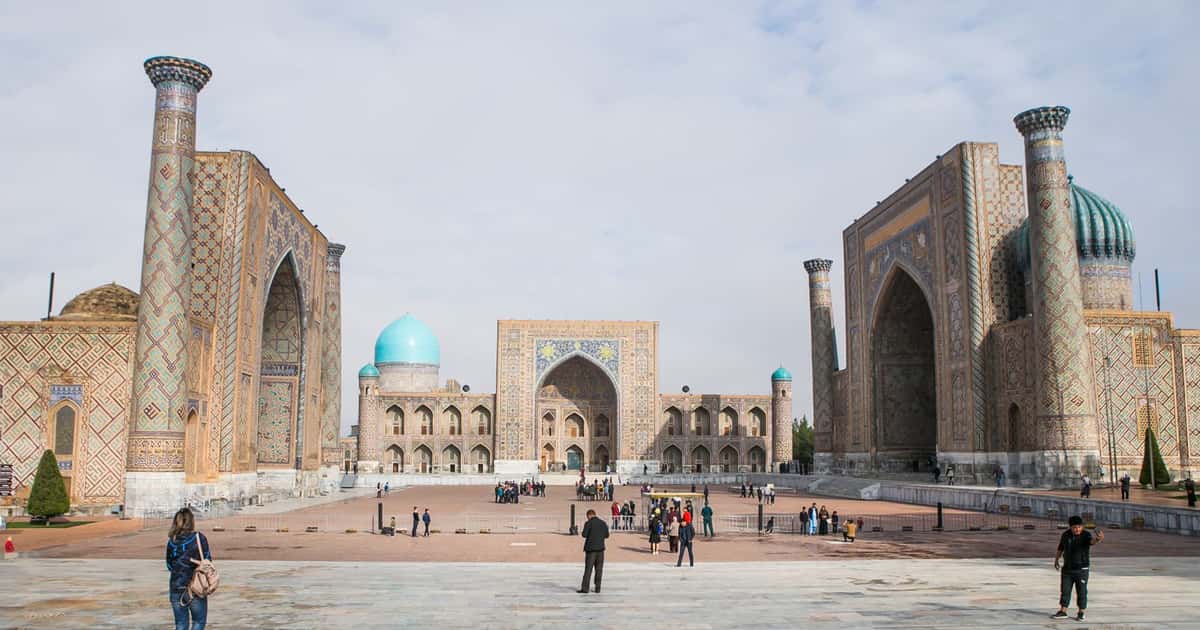
Stand before the Registan at sunset and you understand why travellers have been drawn to Uzbekistan for millennia. Three towering madrasas — their façades a cascade of azure, indigo, and gold tilework — frame a square that was once the intellectual heartbeat of the Islamic world. This is the Silk Road at its most tangible: caravans did not simply pass through but stayed, built, and left behind some of the most extraordinary architecture on earth.
Uzbekistan sits at the geographic centre of Central Asia, a crossroads where empires — Timur, the Samanids, the Shaybanids — left their mark in tiled mosques, fortress walls, and labyrinthine bazaars that still trade in silk, spices, and ceramics. Today, visa rules have loosened, high-speed trains link the major cities, and a new generation of boutique hotels has moved into restored merchant houses and madrasa cells.
This guide covers every Silk Road city — Tashkent, Samarkand, Bukhara, Khiva, the Fergana Valley, and the desert yurt camps — with a ten-day itinerary, transport advice, food recommendations, and everything you need to plan your trip.
Quick Facts at a Glance
- Best time to visit: April–May and September–October (warm days, cool nights, minimal rain)
- Currency: Uzbek som (UZS); cash is king outside Tashkent, though cards are increasingly accepted
- Language: Uzbek (official), Russian widely spoken; English common in tourism sector
- Visa: Many nationalities are visa-free; others use a simple e-visa — check for your passport
- Recommended duration: 10 days for the full Silk Road circuit (Tashkent–Samarkand–Bukhara–Khiva)
- Budget level: Very affordable — one of the best-value destinations in Asia
- Getting around: Afrosiyob high-speed train between Tashkent, Samarkand, and Bukhara; shared taxis and slower trains to Khiva
- Safety: Generally very safe; low street crime, welcoming locals
Why Visit Uzbekistan?
The Silk Road's greatest hits are here. No other country packs so many world-class Silk Road monuments into such a compact, easily navigable circuit. Samarkand, Bukhara, and Khiva are each UNESCO World Heritage Sites, and together they form an architectural timeline spanning more than a thousand years.
Timurid architecture rivals anything in the Islamic world. The decorative programmes of Samarkand's madrasas, Bukhara's mosques, and Khiva's minarets represent the pinnacle of Timurid and Islamic art — geometric mosaics, glazed tile revetments, and painted wooden ceilings executed with a precision that still challenges modern craftsmen.
It is remarkably accessible. A modern high-speed railway links the three main cities. Visa liberalisation means most Western travellers can arrive without paperwork. Tourist infrastructure — from boutique hotels to guided tours to ATMs — has improved enormously in recent years.
The living culture is as compelling as the monuments. This is not a museum country. The bazaars trade as they always have. Master ceramicists in Rishtan and silk weavers in Margilan practise techniques passed down through generations. Plov is still cooked in enormous kazans over wood fires at communal gatherings. A yurt stay under the desert stars is within easy reach.
It is astonishingly affordable. Accommodation, food, transport, and entrance fees are all inexpensive by international standards, making Uzbekistan one of the highest-value travel destinations anywhere.
Uzbekistan Region by Region
Tashkent — The Modern Gateway
Most Silk Road journeys begin in Tashkent, Uzbekistan's capital and largest city. A 1966 earthquake levelled much of the old town, and Soviet planners rebuilt it in grand, tree-lined boulevards. The result feels more Soviet Central Asian than Timurid — but Tashkent rewards those who look closer.
Chorsu Bazaar is the city's pulsing heart. Under a vast green dome, vendors sell spices, dried fruits, nuts, and rounds of non bread still warm from the tandoor. Arrive in the morning when the light pours through the dome and produce is freshest.
The Tashkent Metro — long classified as a military installation, banning photography for decades — is one of the most beautiful subway systems in the former Soviet Union. Stations like Kosmonavtlar (cosmonaut portraits) and Alisher Navoi (blue-domed grand hall) are worth riding for their own sake.
The Khast Imam complex is the city's most important religious site. It houses what is believed to be one of the world's oldest Korans — the Uthman Koran, a caliph-era manuscript dated to the seventh century. The complex itself is a quiet, leafy enclosure of mosques, madrasas, and a striking modern library building whose façade echoes traditional Islamic geometric patterns.
Allow one full day in Tashkent before heading deeper along the Silk Road.
Samarkand — The Crossroads of the World
If Tashkent is the practical gateway, Samarkand is the emotional heart of the Silk Road. Timur made this his capital in the fourteenth century, and his grandson Ulugh Beg continued to embellish it with monuments that still define the skyline.
The Registan Ensemble is the single most iconic sight in Central Asia. Three madrasas — the Ulugh Beg Madrasa (completed in 1420), the Sher-Dor Madrasa (1636), and the Tilya-Kori Madrasa (1660) — face each other across a broad square. Each façade is a masterwork of mosaic tilework: leaping tigers on the Sher-Dor, intricate geometric star patterns on the Ulugh Beg, and lavish gold-leaf decoration inside the Tilya-Kori mosque. Visit at opening time (early morning, when the light is soft and crowds thin), and return at sunset when the tiles seem to glow from within.
Gur-e-Amir is Timur's mausoleum, and its fluted turquoise dome is one of the most photographed structures in Central Asia. Inside, the walls are covered in deep-green onyx and jade — the dark stone of Timur's own cenotaph sits at the centre, though his actual remains lie in a crypt below. The interior feels solemn and intimate, a stark contrast to the bravado of the Registan.
The Bibi-Khanym Mosque was once one of the largest mosques in the Islamic world. Timur commissioned it for his favourite wife, and its enormous arched portal and crumbling minarets give a sense of the sheer ambition of his building programme. Earthquakes and structural flaws have taken their toll — parts of the mosque collapsed and were rebuilt — but the scale remains staggering.
Shah-i-Zinda is a narrow alley of ornate mausoleums stretching up a hillside, each one a jewel box of tilework. The name means "Tomb of the Living King," referring to a cousin of the Prophet Muhammad who, according to legend, is buried here and never truly died. The earliest tombs date to the eleventh century, and the tilework progresses from earthy Seljuk styles to the brilliant blues of the Timurid era. Come in the late afternoon when the light catches the tiles and the crowds thin.
The Ulugh Beg Observatory, perched on a hill outside the city centre, is a reminder that Samarkand was a centre of science as well as art. Ulugh Beg was a ruler and astronomer who compiled star catalogues more accurate than any produced before the telescope. The massive stone sextant — a curved track cut into the ground — survives, and the small museum contextualises his achievements.
Plan two to three full days in Samarkand. The major sites fit into two days, but the city rewards slower exploration — tea breaks in the shadow of the Registan, evenings at Siab Bazaar, and walks through the old neighbourhoods.
Bukhara — The Living Old Town
If Samarkand stuns with monuments, Bukhara captivates with atmosphere. The old town is compact, walkable, and astonishingly intact — a maze of madrasas, mosques, trading domes, and tea houses centred on pools (hauz). UNESCO listed the entire historic centre as a World Heritage Site: one of the best-preserved medieval cities anywhere.
The Po-i-Kalyan Complex is Bukhara's architectural centrepiece. The Kalyan Minaret — nearly fifty metres tall, built in 1127 — soars above the complex. Genghis Khan reportedly spared it because he was so impressed by its height (he destroyed virtually everything else in the city). Flanking the minaret are the Mir-i Arab Madrasa, still an active religious school, and the Kalyan Mosque, one of the largest in Central Asia.
Lyab-i Hauz is the social heart of the old town. A tree-framed pool surrounded by madrasas and a tea house, it is the place to sit with a pot of green tea and watch the evening promenade as families, couples, and tour groups circle the water. The adjacent Nadir Divanbegi Madrasa has a famously quirky portal decorated with animals and a slightly cross-eyed pair of birds — a departure from the geometric norms of Islamic architecture.
The Ark Fortress is a massive, fortified compound that served as the residence of Bukhara's emirs for centuries. Inside, you will find a series of small museums covering the city's history, coronation court, and the grim Zindon prison. Allow an hour or two; the interiors are less spectacular than the buildings around the old town, but the history is compelling.
Bukhara's covered trading domes — Toki Sarrafon, Toki Telpak Furushon, and Toki Zargaron — are where the Silk Road's commercial spirit lives on. Under these brick domes, merchants still sell suzani embroidery, silk scarves, carpets, spices, and jewellery. Haggle politely; it is expected, and it is part of the experience.
Chor Minor, a small and oddly charming structure with four slender minarets rising from a single gatehouse, sits at the edge of the old town. It is a quick visit but one of Bukhara's most photographed landmarks — and an easy walk from Lyab-i Hauz.
Plan two to three full days in Bukhara. The old town is best explored on foot — stop for tea, browse the trading domes, and let the city's rhythm pull you along.
Khiva — The Open-Air Museum
Khiva is the most remote of Uzbekistan's Silk Road cities, requiring a longer journey — but the payoff is extraordinary. The entire Itchan Kala, the walled inner city, is a UNESCO World Heritage Site: a dense concentration of minarets, madrasas, and mosques enclosed by crenellated mud-brick walls rising from the desert.
The Kalta Minor Minaret — a squat, unfinished tower sheathed in turquoise and blue tiles — is Khiva's most recognisable landmark. It was meant to be the tallest minaret in Central Asia but abandoned after its patron died, leaving it dramatically truncated.
The Kuhna Ark, the Khan's fortress-palace, contains a throne room with a spectacular tiled iwan, a reception courtyard, and painted wooden ceilings. Climb the city walls at the Ak Sheikh Bobo observation tower for a sweeping view across the walled city and desert beyond.
The Juma Mosque is distinctive for its forest of carved wooden columns — some reportedly dating to the tenth century — supporting a flat ceiling, giving it an intimate, almost forest-like atmosphere.
The Islam Khoja Minaret, the tallest structure in Khiva at nearly sixty metres, soars above the walls and is visible for miles across the surrounding plain. Its bands of blue and white tilework narrow as the minaret rises, creating a subtle optical illusion of even greater height.
Plan at least one full day and two nights in Khiva. The city is small enough to explore thoroughly in a day, but the evening light on the mud-brick walls — and the quiet of the old town after day-trippers leave — justifies the overnight stay.
The Fergana Valley — Silk, Ceramics, and Craft Traditions
East of Tashkent, the fertile Fergana Valley spreads between mountain ranges. For travellers, the draw is its living craft traditions.
Margilan is the centre of Uzbekistan's silk industry. The Yodgorlik Silk Factory demonstrates the entire process — from cocoon to dyed thread to the hand-woven atlas and adras fabrics used for traditional robes and modern fashion. The patterns are bold, geometric, and distinctively Central Asian.
Rishtan is famed for its cobalt-blue ceramics, using techniques and mineral glazes that have changed little in centuries. Visit a master potter's workshop, watch the wheel and kiln in action, and consider a plate or bowl as a souvenir — they pack well.
The valley can be visited as a day trip or overnight excursion from Tashkent, and it pairs well with the start or end of a Silk Road circuit.
Desert Add-On — Yurt Camps near the Nuratau Mountains and Aydarkul Lake
Between Bukhara and Samarkand, the Kyzylkum Desert stretches toward the Aral Sea basin. Several yurt camps near the Nuratau Mountains and Aydarkul Lake offer a night under the stars in a traditional felt yurt.
This is the nomadic side of Central Asia that cities rarely show. Evenings around a fire with shashlik and bread; night skies dark enough for the Milky Way. By day, hike the foothills, swim in Aydarkul Lake, or ride a camel.
Camps are family-run, basic but comfortable, arranged through guesthouses in Bukhara or Samarkand. One night is enough for most travellers; two if you want to slow down completely.
Top Things to Do
Islamic and Timurid Architecture
Beyond the headline sites, look for Shah-i-Zinda at different times of day (the light changes dramatically), the carved wooden ceilings of Bukhara's Bolo Haouz Mosque, and the tilework of Khiva's Pahlavan Mahmoud Mausoleum — a small building whose interior is one of the finest tile-covered spaces in the country.
Silk Road History and Archaeology
The Afrosiyob Museum in Samarkand displays frescoes from the pre-Islamic Sogdian city that once stood on the same site. In Bukhara, the Ark and Zindon prison tell the darker side of Silk Road history. The Ulugh Beg Observatory connects the Silk Road to the history of science.
Bazaars and Markets
Chorsu Bazaar in Tashkent, Siab Bazaar in Samarkand, and the trading domes of Bukhara are essential experiences. Dried fruits and nuts are exceptional, and fresh non bread varies by region — each city presses its own pattern into the dough.
Traditional Crafts
- Silk weaving in Margilan — watch the entire process at Yodgorlik or a smaller workshop
- Suzani embroidery — the large, richly coloured textile hangings are sold throughout Bukhara and Samarkand; each region has its own patterns
- Rishtan ceramics — cobalt-blue plates, bowls, and tiles
- Wood carving — especially the ornate columns in Khiva's Juma Mosque
- Knife making — Chorsu Bazaar in Tashkent has a section dedicated to traditional Uzbek pichog (knives)
Riding the Afrosiyob High-Speed Train
The Afrosiyob is not just transport — it is an experience. The sleek Spanish-built Talgo covers Tashkent to Samarkand in just over two hours and Samarkand to Bukhara in about ninety minutes, scenery shifting from suburban sprawl to cotton fields to desert fringe. Book early in peak season.
A Night in a Yurt
Spending a night in a yurt is one of Uzbekistan's most memorable experiences — simplicity, landscape, and silence as a powerful counterpoint to the architectural density of the cities.
Suggested Itinerary: 10 Days on the Silk Road
This itinerary assumes you arrive in and depart from Tashkent, using trains for the core route.
Day 1 — Arrive in Tashkent Arrive, settle in, and explore Chorsu Bazaar and the Khast Imam complex. Ride the metro to see the stations. Have your first plov at a local oshxona.
Day 2 — Tashkent to Samarkand Board the morning Afrosiyob train (roughly two hours). Spend the afternoon at the Registan — arrive late enough for the softer light. Browse Siab Bazaar for dinner ingredients or a quick snack.
Day 3 — Samarkand Full day: Gur-e-Amir in the morning, Bibi-Khanym Mosque, then Shah-i-Zinda in the late afternoon. Visit the Afrosiyob Museum if time permits.
Day 4 — Samarkand Morning at the Ulugh Beg Observatory. Afternoon free to revisit the Registan, explore workshops, or visit the paper-making workshops in Konigil village.
Day 5 — Samarkand to Bukhara Take the Afrosiyob or a shared taxi to Bukhara (train takes roughly ninety minutes). Arrive by midday, check in, and spend the afternoon wandering the old town. Evening tea at Lyab-i Hauz.
Day 6 — Bukhara Po-i-Kalyan complex in the morning, the Ark Fortress before lunch, then the trading domes for suzani and ceramics shopping in the afternoon. Visit Chor Minor at golden hour.
Day 7 — Bukhara A slower day — revisit favourite spots, take a cooking class, or visit the Zindon prison and Chor Bakr necropolis. This is also a good day for a yurt camp excursion.
Day 8 — Bukhara to Khiva Take an early train or shared taxi to Khiva (roughly six hours). Arrive by mid-afternoon and walk the Itchan Kala walls at sunset. The evening light on the mud-brick fortifications is extraordinary.
Day 9 — Khiva Full day exploring Itchan Kala: Kuhna Ark, Juma Mosque, Kalta Minor, Islam Khoja Minaret, Pahlavan Mahmoud Mausoleum. Climb the city walls for panoramic views.
Day 10 — Khiva to Tashkent Fly from Urgench (the nearest airport, about thirty minutes from Khiva) back to Tashkent, or take the long overnight train if you prefer to maximise time on the ground. Depart from Tashkent.
Best Time to Visit Uzbekistan
Spring (April–May) is the most popular time. Daytime temperatures sit comfortably in the low to mid-twenties Celsius, wildflowers bloom, and bazaars overflow with fresh produce. Book trains and hotels well in advance.
Autumn (September–October) is equally appealing. The heat has faded, air is clear, and the quality of light on tilework is superb for photography. September can still be warm; October is ideal.
Summer (June–August) is brutally hot — daytime temperatures regularly exceed 40°C with little shade. If you must travel now, sightsee early morning and late afternoon, retreat indoors midday, and stay hydrated.
Winter (December–February) is cold and grey. Snow is possible. The upside: virtually no tourists, lower prices, and tilework looks striking against overcast skies.
Getting There & Around
Arriving in Uzbekistan
Tashkent Islam Karimov International Airport (TAS) is the main gateway, with direct flights from Istanbul, Dubai, Frankfurt, Moscow, Beijing, Seoul, and others. The airport is modern; immigration is typically straightforward.
Between Cities
- Afrosiyob high-speed train: Connects Tashkent–Samarkand (just over two hours) and Samarkand–Bukhara (ninety minutes). Book a few days ahead in peak season.
- Regular trains: Slower but cheaper, connecting all cities including Urgench (for Khiva). The overnight train to Urgench is popular and saves a hotel night.
- Shared taxis: Available between all cities; faster than regular trains, less comfortable than the Afrosiyob. Agree on the price before departure.
- Domestic flights: Uzbekistan Airways flies Tashkent to Urgench — the fastest way to reach or leave Khiva.
Within Cities
Tashkent has the metro. In Samarkand, Bukhara, and Khiva, the old towns are compact enough to explore on foot. Taxis are inexpensive; use a ride-hailing app or agree on a fare before the trip.
Where to Stay
Bukhara offers the most atmospheric accommodation — boutique hotels in restored madrasas and merchant houses inside the old town, with carved wooden columns, courtyards with fruit trees, and modern plumbing. The area around Lyab-i Hauz has the best concentration.
Khiva has hotels inside the Itchan Kala walls, some in converted madrasa cells. Staying inside the walled city after day-trippers leave is an experience worth seeking out.
Samarkand's hotel scene is growing, with renovated Soviet-era properties and new boutique hotels in traditional style. Look for options within walking distance of the Registan.
Tashkent has the widest range, from international business hotels to small guesthouses. For Silk Road atmosphere, stay in the old town near Chorsu Bazaar rather than the Soviet centre.
Budget travellers will find clean, well-run guesthouses in every city. Mid-range boutique hotels represent outstanding value. At the top end, restored heritage properties offer a level of character that few new-build luxury hotels can match.
Food & Drink
Uzbek cuisine is hearty, meat-centric, and deeply satisfying — nomadic, Persian, and Russian influences colliding along the Silk Road.
Plov (also called osh) is the national dish. Rice is cooked with lamb or beef, carrots, onions, and generous oil in a large cast-iron kazan over an open flame. Every region has its version: Samarkand's is lighter and yellower, Bukhara's darker and more spiced, the Fergana Valley's richer. The best plov comes from dedicated plov centres (oshxona), ideally at lunchtime when freshly made.
Samsa are savoury tandoor-baked pastries — flaky outside, filled with spiced lamb and onion (or pumpkin or cheese). Perfect on-the-go breakfast or snack.
Shashlik — grilled lamb or beef skewers — are sold everywhere, eaten with raw onion, vinegar, and non bread.
Non is the ubiquitous round bread, stamped with decorative patterns and baked in a tandoor. Each city's non is different — Samarkand's is larger and flatter, Tashkent's thicker. Never place it upside down (a cultural taboo).
Green tea (kok choy) is the default drink, served constantly and refilled without asking. Black tea is also common. In the Fergana Valley, look for kaymok — a clotted cream served with non and tea as a luxurious breakfast.
Alcohol is available in restaurants and hotel dining rooms (a Soviet-era legacy), but the drinking culture is moderate. In local eateries, tea is the focus.
Costs & Budgeting
Uzbekistan is one of the best-value destinations in Asia.
Accommodation ranges from inexpensive guesthouses to mid-range boutique hotels costing a fraction of comparable properties in Turkey or Morocco. Heritage hotels in Bukhara and Khiva are remarkably affordable given their uniqueness.
Food is inexpensive across the board. A meal at a local oshxona or chaihana costs very little; even mid-range dining is light on the wallet.
Transport is excellent value. The Afrosiyob is affordable for its speed and comfort; shared taxis between cities are inexpensive.
Entrance fees to monuments and museums are modest. A single ticket in Samarkand covers multiple Registan buildings.
Overall, budget travellers can explore comfortably on modest daily spending. Mid-range travellers will find their money goes far, and those spending a bit more can stay in extraordinary heritage properties.
Safety & Practical Tips
- Safety: Uzbekistan is generally very safe. Violent crime is rare, and most travellers feel comfortable walking in city centres at night. Guard against pickpockets in crowded bazaars.
- Currency: The Uzbek som (UZS). Carrying cash is essential in Bukhara, Khiva, and smaller towns. ATMs are common in Tashkent and Samarkand but less reliable elsewhere. Exchange at banks or official offices; US dollars and euros are easiest to exchange.
- Visa: Many nationalities enter visa-free for up to 90 days; others use a straightforward e-visa. Check current requirements for your passport before booking — policies continue to evolve.
- Dress code: Uzbekistan is a secular Muslim-majority country. Dress is modern and relaxed in cities. At mosques, mausoleums, and religious complexes, dress modestly — cover shoulders and knees. A lightweight scarf is useful. Women are not required to cover their hair except inside active mosques.
- Water: Do not drink tap water. Bottled water is cheap and available everywhere.
- Photography: Generally welcome. Some museums and interiors charge a small extra fee for camera use. Always ask before photographing people — most Uzbek people are happy to oblige.
- Connectivity: SIM cards with data are cheap at the airport or mobile shops. Coverage is good in cities.
- Haggling: Expected in bazaars. Do it politely and with a smile.
- Language: Uzbek is the official language; Russian is widely spoken. English is increasingly common in tourism. A few words of Uzbek — "rahmat" (thank you), "assalomu alaykum" (hello) — go a long way.
Final Thoughts
Uzbekistan is one of those rare destinations that exceeds the hype. The Silk Road is not a marketing label here — it is the literal foundation of three great cities, each a masterwork of Islamic architecture embedded in a living culture. The tilework of Samarkand's Registan, the atmospheric lanes of Bukhara's old town, the walls of Khiva's Itchan Kala — these are places that change how you think about history and beauty.
Add a fast railway, visa-free entry for most nationalities, warm hospitality, extraordinary food, and costs that make extended travel genuinely accessible. Whether you have ten days for the classic circuit or three weeks to explore deeper, Uzbekistan rewards the journey — and invites you back before you have even left.
Frequently Asked Questions
Uzbekistan is widely regarded as one of the safest countries in Central Asia for travellers. Street crime is rare, police are generally helpful, and locals are famously hospitable. Use common-sense precautions as you would anywhere — watch your belongings in crowded bazaars and stick to well-lit areas at night.
The ideal windows are April through May and September through October, when daytime temperatures are warm but not oppressive and skies are clear. Summers (June–August) regularly exceed 40°C in the cities, making sightseeing uncomfortable. Winters (December–February) are cold, with occasional rain and snow, though hotel rates drop.
Uzbekistan has dramatically liberalised its visa regime. Citizens of many countries — including most European nations, the United Kingdom, Turkey, Japan, South Korea, and several others — can enter visa-free for stays of up to 30 to 90 days. Other nationalities can use a straightforward e-visa system. Always verify the current requirements for your passport before booking.
A well-paced 10-day trip covers Tashkent, Samarkand, Bukhara, and Khiva with time to absorb each city. You can see the highlights of Samarkand and Bukhara in as few as seven days if you skip Khiva, but the overnight journey to Khiva's Itchan Kala is worth the extra time.
The Afrosiyob high-speed train connects Tashkent, Samarkand, and Bukhara in under four hours end to end — it is comfortable, reliable, and far easier than flying. For Khiva, take a train or shared taxi from Bukhara (roughly six hours). Shared taxis operate between all cities and are inexpensive, though less comfortable than the train.
They offer different experiences. Samarkand stuns with monumental architecture — the Registan, Shah-i-Zinda, and Gur-e-Amir are among the most spectacular Islamic monuments anywhere. Bukhara is more atmospheric: a compact, living old town where you wander past madrasas, trading domes, and tea houses still in daily use. Ideally, visit both.
The national currency is the Uzbek som (UZS). While card acceptance is growing in Tashkent and larger hotels, cash remains essential in bazaars, smaller restaurants, and in Bukhara and Khiva. ATMs are common in cities. Bring crisp foreign-currency notes (US dollars or euros) as a backup and exchange at banks or official exchange points.
Adventure Knit Editorial
Destination research compiled and fact-checked by the Adventure Knit editorial team from published sources, operator itineraries, and official tourism boards. Spot something out of date? Tell us at hello@adventureknit.com.
Related Stories
 Greece
Athens Greece: Ultimate Ancient Civilization Travel Guide
Complete Athens travel guide covering Acropolis, Parthenon, Plaka, and Greek cuisine. Expert tips for your perfect Greek adventure.
 United Kingdom
Bath United Kingdom: Ultimate Roman Spa City Travel Guide
Complete Bath travel guide covering Roman Baths, Georgian architecture, Jane Austen heritage, and English countryside. Expert tips for your perfect UK adventure.
 Serbia
Belgrade Serbia: Ultimate Balkan Capital Travel Guide
Complete Belgrade travel guide covering Kalemegdan Fortress, Skadarlija Park, Serbian cuisine, and Balkan culture. Expert tips for your perfect Serbian adventure.
Enjoyed this article?
Explore more stories from our adventures around the world