
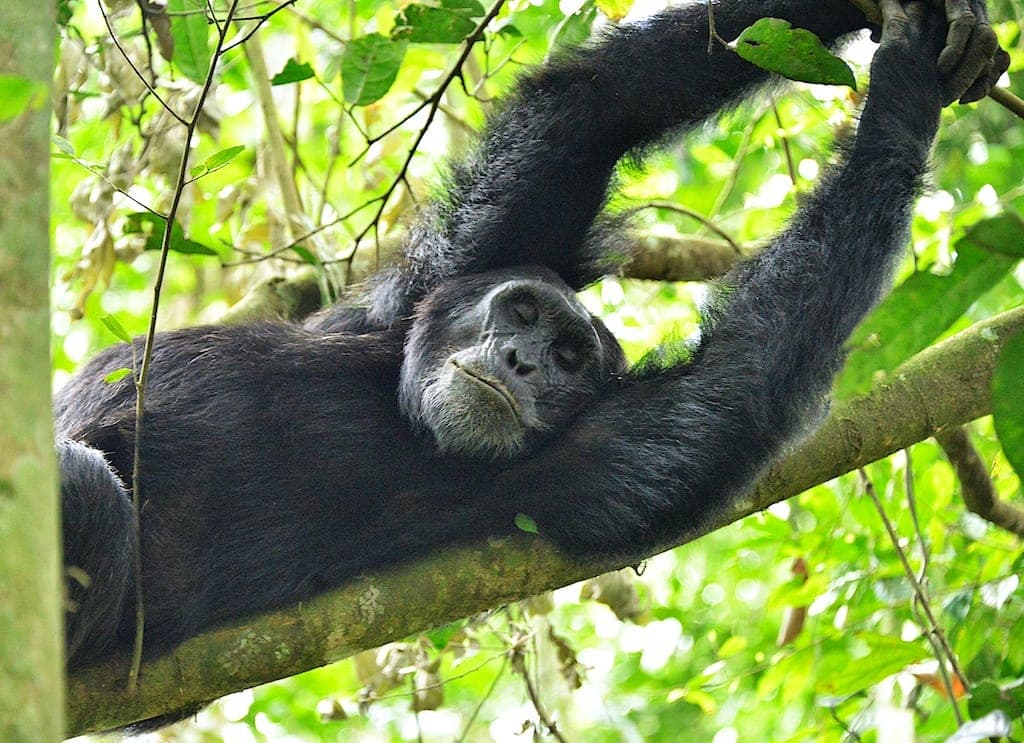
Chimpanzee Tracking in Kibale Forest, Uganda: How It Actually Works
Categories
Tags
Chimpanzee tracking in Kibale National Park, western Uganda, is a guided activity run by the Uganda Wildlife Authority with two daily departures from the Kanyanchu Visitor Centre, typically at 08:00 and 14:00. A standard permit has recently cost around 250 US dollars for foreign non-residents and gives one hour with the chimpanzees after a walk of thirty minutes to three hours over flat to gently rolling forest floor. The drier months of June-September and December-February make for the easiest walking, though tracking runs year-round.
Chimpanzee tracking in Kibale Forest, Uganda
Kibale National Park sits in western Uganda between the Rwenzori foothills and the crater-lake country around Fort Portal. It protects roughly 795 km² of moist evergreen rainforest and holds thirteen primate species — the highest primate density in East Africa — including a chimpanzee population usually estimated at around 1,500 animals.
Tracking them is a permitted, guided activity run by the Uganda Wildlife Authority (UWA), not a walk you can do on your own. This guide covers how the day is structured, what a permit costs, and how the activity slots into a wider Uganda itinerary.
Fees and rules below were accurate at the time of writing. UWA reviews tariffs periodically — confirm the current figures at ugandawildlife.org or with your operator before you budget.
The two options: a tracking permit or a habituation day
Standard chimpanzee tracking departs twice daily from the Kanyanchu Visitor Centre, typically at 08:00 and 14:00. You are briefed, split into a small group (six visitors per chimpanzee group is the usual cap), and walked into the forest with a UWA ranger and trackers who have been following the community since dawn. Once the chimps are located you get one hour with them. The permit has recently sat at around US$250 for foreign non-residents.
The Chimpanzee Habituation Experience (CHEX) is a different product: you join the researchers and trackers for a full day with a community that is still being habituated, from the moment they leave their night nests to the moment they build new ones. It costs more — in the region of US$300 — and is offered mainly in the low-season months (roughly March to May and November), when demand for standard permits is lower.
The trade-off is straightforward. The standard permit gives you a near-certain, tightly managed hour. Habituation gives you the whole day and a much better sense of how chimpanzee society works, with less predictable viewing because the animals are less relaxed around people.
What the walk is like
The forest floor is flat to gently rolling — this is nothing like the steep, tangled climb of a gorilla trek. What makes it demanding is heat, humidity, and pace: when the trackers radio a location, the group moves quickly, sometimes off-trail through undergrowth.
Expect anywhere from thirty minutes to three hours of walking before contact, and a real chance that the chimps are high in the canopy when you find them. Chimpanzees are noisy, mobile and social; the experience is less about a still, close-up encounter than about being inside a moving community — pant-hoots carrying through the trees, juveniles wrestling, adults grooming or dragging branches in display.
Thirteen primate species live here, so the walk regularly turns up red colobus, black-and-white colobus, grey-cheeked mangabey, L'Hoest's monkey and olive baboon along the way.
Rules that are actually enforced
- Minimum age 12 for chimpanzee tracking (gorilla trekking in Uganda is 15).
- Keep your distance — the standing guidance is roughly 8 metres, and rangers do enforce it.
- Masks are required during viewing. Chimpanzees share enough of our physiology to catch our respiratory infections, and outbreaks in habituated communities have killed animals.
- Do not track if you are ill. A cold is a genuine risk to the community, and a refund or reschedule is easier to arrange than you would expect.
- No flash photography, no food in view of the animals, no attempts to move closer for a shot.
What to bring
Long trousers and long sleeves (safari ants and stinging nettles are the reason, not the temperature), broken-in boots with grip, a light rain jacket in any month, at least two litres of water, insect repellent, and gardening-weight gloves if you dislike grabbing unfamiliar vegetation. Gaiters are worth the space in a bag. A camera that performs in low, dappled light will serve you far better than a long lens: much of the time you are shooting up into shade.
Porters are usually available at the visitor centre and are worth hiring — it is a direct, useful transfer of tourism money into the villages around the park.
When to go
Chimpanzee tracking runs year-round. The drier stretches — roughly June to September and December to February — make the forest floor easier and the walking faster. The wetter months bring more fruit, which can concentrate chimps at lower levels and make viewing better, at the cost of mud and a higher chance of rain during your hour.
If the habituation experience is your priority, plan around its low-season availability rather than around the weather.
Getting there, and what else is nearby
Kibale is roughly a five- to six-hour drive west from Kampala or Entebbe via Mubende and Fort Portal, on tarmac for most of the way. Most visitors arrive the afternoon before an 08:00 departure and stay near Kanyanchu or in the Fort Portal crater-lakes area.
Two additions worth the time:
- Bigodi Wetland Sanctuary, a community-run swamp walk on the park's edge, is the best birding morning in the region and one of Uganda's longest-standing community tourism projects.
- The crater lakes around Fort Portal — Nyinambuga, Nkuruba, Lyantonde — make a genuinely restful day between long drives.
How it fits a gorilla safari
Kibale is the natural pairing with Bwindi. A typical circuit runs Entebbe → Kibale (chimpanzees) → Queen Elizabeth National Park (game drives, the Kazinga Channel, the tree-climbing lions of Ishasha) → Bwindi Impenetrable Forest (mountain gorillas), then back to Entebbe or out via a domestic flight from Kihihi.
Both of the Uganda trips currently listed on Adventure Knit are built on that spine and include an hour with chimpanzees and an hour with gorillas:
- Gorillas & Chimps Luxury Safari — the two primate encounters with luxury lodges.
- Uganda Ultimate Luxury Safari — the same primates plus Murchison Falls, Queen Elizabeth and Lake Mburo for Big Five game drives and walks.
You can also see everything currently bookable in the country on the Uganda tours page, and read the companion guides on our Uganda hub.
The practical checklist
- Decide between a standard permit and the habituation day, then book early — permits are capped and peak-season dates sell out months ahead.
- Confirm current permit fees with UWA or your operator before budgeting.
- Check that your itinerary allows a night near Kanyanchu; a same-day arrival from Kampala is a bad idea for an 08:00 briefing.
- Bring a yellow fever vaccination certificate — Uganda requires one on entry — and arrange your visa (e-visa or the East Africa Tourist Visa) in advance.
- Pack for rain in every month. This is rainforest.
Frequently Asked Questions
The standard tracking permit has recently sat at around 250 US dollars for foreign non-residents, giving one hour with a habituated chimpanzee community. The full-day Chimpanzee Habituation Experience costs more, in the region of 300 US dollars. The Uganda Wildlife Authority reviews its tariffs periodically, so confirm current figures with UWA or your operator before budgeting.
Standard tracking is a tightly managed, near-certain hour with a fully habituated community, in groups capped at six visitors. The Chimpanzee Habituation Experience is a full day alongside researchers and trackers with a community still being habituated, from night nest to night nest, and is offered mainly in the low-season months of roughly March to May and November. Habituation gives a deeper view of chimpanzee society but less predictable viewing, since the animals are less relaxed around people.
The forest floor is flat to gently rolling, so it is nothing like the steep climb of a gorilla trek. The challenge comes from heat, humidity, and pace — when trackers radio a location the group moves quickly, sometimes off-trail through undergrowth. Expect thirty minutes to three hours of walking before contact, and note the minimum age is 12.
Tracking runs year-round with no closed season. The drier stretches, roughly June to September and December to February, make the forest floor easier and the walking faster. Wetter months bring more fruit, which can concentrate chimps at lower levels and improve viewing, at the cost of mud and a higher chance of rain during your hour.
Kibale is roughly a five- to six-hour drive west from Kampala or Entebbe via Mubende and Fort Portal, on tarmac for most of the way. Most visitors arrive the afternoon before an 08:00 departure and stay near Kanyanchu or in the Fort Portal crater-lakes area. A same-day arrival from Kampala is a bad idea for a morning briefing.
Rangers enforce a distance of roughly 8 metres, masks are required during viewing because chimpanzees can catch human respiratory infections, and flash photography and food in view of the animals are banned. Visitors who are ill should not track, as a cold is a genuine risk to the community. The minimum age is 12, versus 15 for gorilla trekking in Uganda.
Adventure Knit Editorial
Destination research compiled and fact-checked by the Adventure Knit editorial team from published sources, operator itineraries, and official tourism boards. Spot something out of date? Tell us at hello@adventureknit.com.
Related Stories
 Uganda
Bwindi Impenetrable Forest Uganda: Mountain Gorilla Trekking Guide
Expert guide to mountain gorilla trekking in Bwindi Impenetrable Forest, Uganda. Gorilla encounters, trekking tips, permits, and conservation insights.
 Uganda
Planning a Uganda Gorilla and Chimp Safari: Permits, Seasons and Real Costs
How to plan a Uganda safari that combines mountain gorillas in Bwindi with chimpanzees in Kibale: what permits cost, when to go, how long it takes, and what a realistic budget looks like.
 Uganda
Murchison Falls National Park: Where the Nile Explodes Through a Seven-Metre Gap
A practical guide to Murchison Falls National Park, Uganda: the boat cruise to the falls, game drives on the northern bank, the top-of-the-falls hike, Ziwa's rhinos en route, and how it fits a Uganda safari.
Enjoyed this article?
Explore more stories from our adventures around the world