
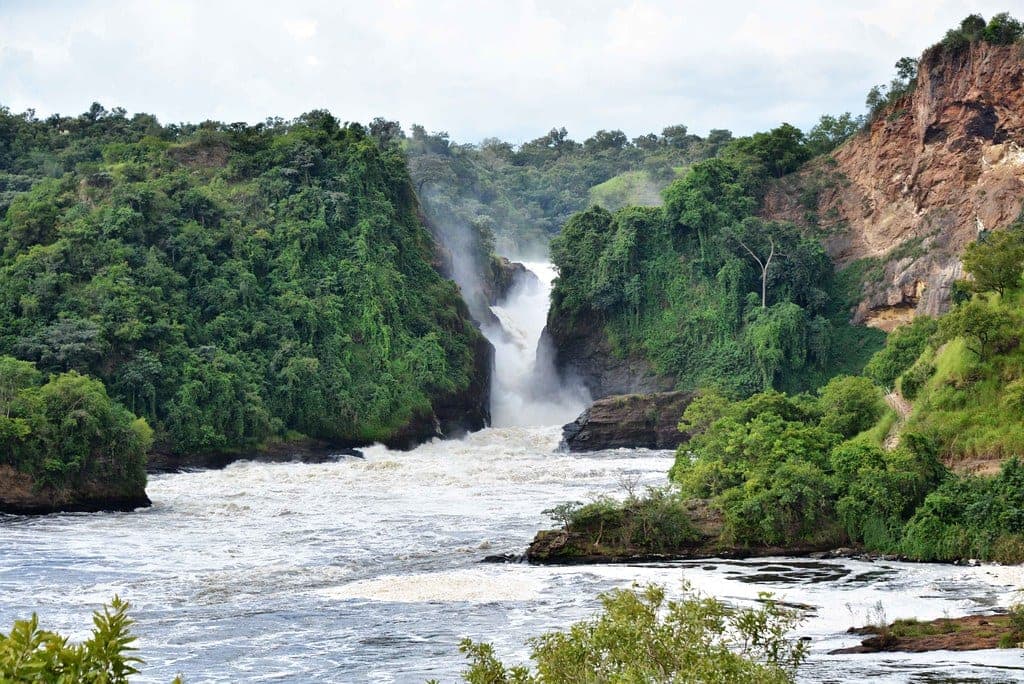
Murchison Falls National Park: Where the Nile Explodes Through a Seven-Metre Gap
Categories
Tags
Murchison Falls National Park is Uganda's largest national park, roughly 3,893 km² straddling the Victoria Nile about 4-5 hours' drive north-west of Kampala. Its namesake falls force the entire Nile through a gap about seven metres wide in a 43-metre drop — best seen from the afternoon boat cruise upriver and the short hike to the top of the falls. Game drives on the northern bank reliably produce elephants, giraffes, lions, buffalo and huge hippo numbers, and a stop at Ziwa Rhino Sanctuary en route adds white rhino on foot. The drier windows of December-February and June-September are best.
The most violent stretch of the Nile
At Murchison Falls, the Victoria Nile — a river already draining Lake Victoria — meets a crack in the Rift escarpment about seven metres wide and goes through it, all of it, falling roughly 43 metres into a permanent boil of spray and rainbows. The thunder carries for kilometres. Uganda's largest national park (roughly 3,893 km²) spreads out from this point along both banks, and everything an itinerary does here orbits the river.
The three set pieces
The boat cruise to the base of the falls. The classic afternoon: a launch trip upriver from Paraa, past pods of hippos in the dozens, huge Nile crocodiles on the sandbars, elephants and buffalo coming down to drink, and fish eagles at intervals of what feels like every third tree. The boat holds position where the gorge narrows and the falls fill the view ahead.
The top-of-the-falls hike. From a drop-off point near the base, a 45-minute trail climbs to the lip — and this is the angle that makes the place make sense: you stand a few metres from the gap watching the entire Nile funnel past your feet. Combine boat up, hike, and vehicle pick-up at the top in one seamless afternoon.
Northern-bank game drives. The savannah north of the river is Uganda's best classic game viewing: elephant herds, Rothschild's giraffe (this park holds one of the world's most important populations), lion prides working the borassus-palm grasslands, buffalo, and dense herds of Uganda kob. Leopard turns up along the riverine fringes. Birders come for more than 450 species, with the prehistoric shoebill possible where the river fans into its delta toward Lake Albert.
Rhinos on the way in
The park itself has no rhinos — poaching eliminated them decades ago — but Ziwa Rhino Sanctuary, directly on the Kampala–Murchison road, protects a breeding population of southern white rhino that you track on foot with rangers. Nearly every road itinerary builds in the stop, and it is what turns a Uganda safari into a genuine Big Five trip.
How it fits a Uganda itinerary
Murchison anchors the northern loop of the classic Uganda circuit; the gorilla and chimp forests anchor the south-west. A full traverse runs Entebbe → Ziwa → Murchison Falls → Kibale (chimpanzees) → Queen Elizabeth (Kazinga Channel, tree-climbing lions) → Bwindi (mountain gorillas) — the "Pearl of Africa" grand tour.
That is exactly the spine of the Uganda Ultimate Luxury Safari currently listed on Adventure Knit: Murchison Falls, Kibale, Queen Elizabeth, Bwindi and Lake Mburo, with an hour with the gorillas, an hour with the chimps, Big Five game drives and luxury lodges throughout. If your trip is primates-first, the Gorillas & Chimps Luxury Safari concentrates on Bwindi and Kibale.
Everything currently bookable in the country is on the Uganda tours page, with planning help in our Uganda gorilla and chimp safari guide and the rest of the guides on the Uganda hub.
Practical notes
- Give it two nights. One day for the boat-and-hike set piece, one morning for the northern-bank game drive, is the minimum that doesn't feel like a transit stop.
- Book the afternoon boat — the light on the falls and the animal traffic on the banks are both better than at midday.
- Park fees are charged per 24 hours by the Uganda Wildlife Authority and revised periodically; confirm what your quote includes.
- Yellow fever certificate and visa are Uganda entry requirements — sort both before travel.
- Malaria precautions matter here more than in the highland gorilla areas: prophylaxis, repellent, and covered arms at dusk.
Frequently Asked Questions
The compression: the Victoria Nile, tens of metres wide upstream, is forced through a cleft about seven metres across and drops roughly 43 metres in a permanent explosion of whitewater. Winston Churchill and generations of travellers since have rated it East Africa's most dramatic sight of its kind, and the park around it is Uganda's biggest savannah wildlife area.
Two ways, best combined: the afternoon boat cruise from Paraa upriver to the base of the falls — passing hippos, crocodiles and elephants drinking — and the 45-minute hike from the boat drop-off point to the top of the falls, where you stand beside the gap as the river funnels through. Most itineraries do the boat and hike on one day and game drives the next morning.
The northern-bank savannah holds elephant, Rothschild's giraffe, lion, leopard, buffalo, Uganda kob, Jackson's hartebeest, oribi and patas monkey, with enormous hippo and Nile crocodile populations in the river and over 450 bird species — the shoebill is possible in the delta area. Rhinos are absent from the park itself but are tracked on foot at Ziwa Rhino Sanctuary on the road from Kampala, which is how Uganda itineraries complete the Big Five.
Roughly 300 km — about 4-5 hours' drive to the southern sector, commonly broken by the Ziwa rhino-tracking stop. Charter and scheduled light aircraft also serve airstrips near Paraa for those short on time.
The drier windows — December to February and June to September — concentrate game near the river and keep the black-cotton tracks passable. The park is open and rewarding year-round, though the March-May and October-November rains can slow the northern-bank circuits.
Adventure Knit Editorial
Destination research compiled and fact-checked by the Adventure Knit editorial team from published sources, operator itineraries, and official tourism boards. Spot something out of date? Tell us at hello@adventureknit.com.
Related Stories
 Uganda
Queen Elizabeth National Park: The Kazinga Channel, Ishasha's Tree-Climbing Lions and Uganda's Busiest Ecosystem
A practical guide to Queen Elizabeth National Park, Uganda: the Kazinga Channel boat cruise, Kasenyi's lions, the tree-climbing lions of Ishasha, crater lakes, and how the park bridges Kibale and Bwindi on a Uganda safari.
 Uganda
Planning a Uganda Gorilla and Chimp Safari: Permits, Seasons and Real Costs
How to plan a Uganda safari that combines mountain gorillas in Bwindi with chimpanzees in Kibale: what permits cost, when to go, how long it takes, and what a realistic budget looks like.
 South Africa
Night Safaris in Kruger: What You Actually See After Dark
A practical guide to night drives in Kruger National Park: how the ranger-led drives from rest camps work, the nocturnal animals you can realistically expect, spotlight etiquette, and how to book one into a safari.
Enjoyed this article?
Explore more stories from our adventures around the world