
Queen Elizabeth National Park: The Kazinga Channel, Ishasha's Tree-Climbing Lions and Uganda's Busiest Ecosystem
Categories
Tags
Queen Elizabeth National Park covers roughly 1,978 km² of savannah, crater lakes and wetland in western Uganda, between the Rwenzori foothills and Lakes Edward and George. Its two signatures are the Kazinga Channel boat cruise — arguably Africa's most concentrated hippo viewing, with elephants and buffalo lining the banks — and the tree-climbing lions of the remote Ishasha sector. Game drives on the Kasenyi plains add lion and huge Uganda kob herds, and over 600 bird species make it Uganda's richest birding park. It sits naturally between Kibale's chimps and Bwindi's gorillas on the classic circuit; December-February and June-September are the drier, easier months.
Uganda's busiest ecosystem
Queen Elizabeth National Park is where Uganda's habitats pile on top of each other: savannah grasslands scattered with volcanic crater lakes, the wetland margins of Lakes Edward and George, tropical forest in the Kyambura Gorge, and the Rwenzori Mountains standing on the northern horizon. Roughly 1,978 km² holds ten primate species, north of 600 bird species — the national record — and the wildlife set pieces below.
Giraffe and zebra are famously absent (they live in Uganda's other savannah parks); what Queen Elizabeth offers instead is density along its water.
The set pieces
The Kazinga Channel cruise. A natural channel, 32 km long, links Lake George to Lake Edward through the middle of the park, and its banks are one of Africa's great wildlife waterfronts: hippos in extraordinary concentration — figures in the thousands are commonly cited for the channel — with elephant and buffalo herds coming down to drink, Nile crocodiles hauled out on the mud, and pelicans, cormorants and kingfishers working the whole length. The two-hour launch cruise, typically in the afternoon, is the single best thing the park does.
Kasenyi plains game drives. The park's classic savannah sector, at its best at dawn: lion prides that specialise in hunting the huge herds of Uganda kob around their breeding grounds, side-striped jackal, and spotted hyena. Leopard works the cactus-like euphorbia thickets.
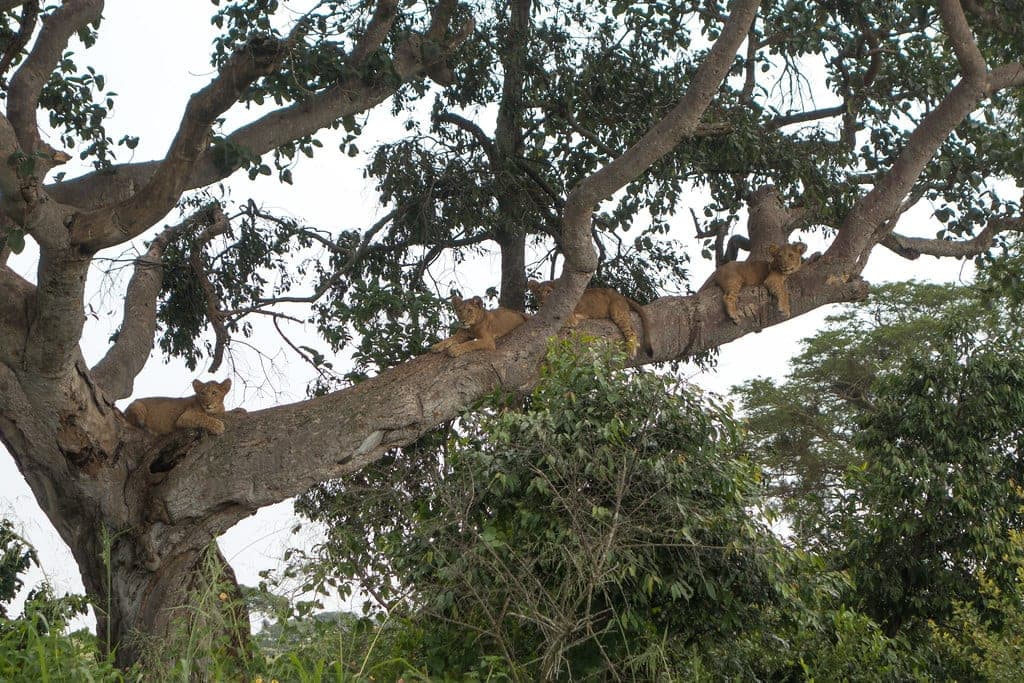
Ishasha's tree-climbing lions. The remote southern sector's lions spend their days draped in the limbs of old fig trees — one of only a few lion populations in Africa known for making a habit of it. Ishasha lies conveniently on the dirt route south toward Bwindi, so most itineraries pass through it exactly when it's most useful.
Kyambura Gorge. A sunken ribbon of rainforest in the savannah, home to a habituated chimpanzee community trackable on ranger-led walks — a shorter, cheaper alternative to Kibale, with lower sighting odds.
How it fits the classic circuit
Queen Elizabeth is the bridge of the south-western loop: Kibale (chimps) → Queen Elizabeth (Kazinga, Kasenyi, Ishasha) → Bwindi (gorillas), with Murchison Falls extending the loop north. Two nights here is the itinerary sweet spot.
The Uganda Ultimate Luxury Safari currently listed on Adventure Knit runs this full spine — Murchison Falls, Kibale, Queen Elizabeth, Bwindi and Lake Mburo, with an hour with gorillas, an hour with chimps, and Big Five game drives from luxury lodges. The Gorillas & Chimps Luxury Safari is the concentrated primate version. Both are on the Uganda tours page, and the planning fundamentals — permits, seasons, real costs — are in our Uganda safari planning guide, with everything else on the Uganda hub.
Practical notes
- Book the afternoon Kazinga cruise — bank traffic peaks as the day cools, and the light is on the animals.
- Dawn matters on Kasenyi. The lion-and-kob theatre happens early; a 06:30 gate start earns its alarm.
- Park fees are charged per 24 hours by the Uganda Wildlife Authority and revised periodically — confirm inclusions in any quote.
- Ishasha adds real driving time on dirt roads; treat it as part of the Bwindi transfer rather than a detour and it costs you nothing.
- Equator photo stop: the park straddles the line, and the monument on the Kasese road is the circuit's obligatory picture.
Frequently Asked Questions
A natural 32-km waterway connecting Lake George to Lake Edward, bisecting the park. Its banks hold one of Africa's great concentrations of hippos — commonly quoted in the thousands across the channel — plus elephants, buffalo and crocodiles coming to drink, and enormous waterbird colonies. The two-hour launch cruise along it is the park's flagship activity and runs daily.
The Ishasha sector, the remote southern arm of Queen Elizabeth National Park. Its lions habitually lounge in the limbs of large fig trees — a behaviour reliably associated with only a handful of populations in Africa, Lake Manyara in Tanzania being the other famous one. Sightings are good but never guaranteed; Ishasha conveniently sits on the driving route from the main park toward Bwindi.
Elephant, buffalo, hippo in huge numbers, lion, leopard, spotted hyena, Uganda kob, waterbuck, topi in Ishasha, and both chimpanzees (in the Kyambura Gorge) and ten primate species overall. Giraffes and zebras are absent — they belong to other Ugandan parks. Birdlife tops 600 species, the most of any Ugandan protected area.
Two nights is the sweet spot: a Kasenyi-plains game drive and the Kazinga Channel cruise fill one full day, and the Ishasha sector works as either a dedicated second day or an en-route half-day when driving south to Bwindi.
The drier windows of December-February and June-September make tracks easier and concentrate game; the park sits near the equator, so temperatures barely move year-round. The rains (March-May, October-November) bring lush scenery and fewer vehicles at the cost of some slick roads.
Adventure Knit Editorial
Destination research compiled and fact-checked by the Adventure Knit editorial team from published sources, operator itineraries, and official tourism boards. Spot something out of date? Tell us at hello@adventureknit.com.
Related Stories
 Uganda
Planning a Uganda Gorilla and Chimp Safari: Permits, Seasons and Real Costs
How to plan a Uganda safari that combines mountain gorillas in Bwindi with chimpanzees in Kibale: what permits cost, when to go, how long it takes, and what a realistic budget looks like.
 Uganda
Murchison Falls National Park: Where the Nile Explodes Through a Seven-Metre Gap
A practical guide to Murchison Falls National Park, Uganda: the boat cruise to the falls, game drives on the northern bank, the top-of-the-falls hike, Ziwa's rhinos en route, and how it fits a Uganda safari.
 South Africa
Night Safaris in Kruger: What You Actually See After Dark
A practical guide to night drives in Kruger National Park: how the ranger-led drives from rest camps work, the nocturnal animals you can realistically expect, spotlight etiquette, and how to book one into a safari.
Enjoyed this article?
Explore more stories from our adventures around the world