
Kilimanjaro's Marangu Route: The Hut Route, Honestly Assessed
Categories
Tags
The Marangu Route — the 'Coca-Cola route' — is Kilimanjaro's oldest trail and the only one where you sleep in huts (Mandara, Horombo, Kibo) instead of tents. It climbs the mountain's south-eastern side to Uhuru Peak at 5,895 m and descends the same path, over 5 or 6 days. Its gradients are the gentlest of the classic routes, but the 5-day version has the weakest acclimatization profile on the mountain and correspondingly low summit rates — take the 6-day itinerary with its Horombo acclimatization day. Supported climbs start around US$1,600-2,000; best months are January-February and June-October.
What makes Marangu different
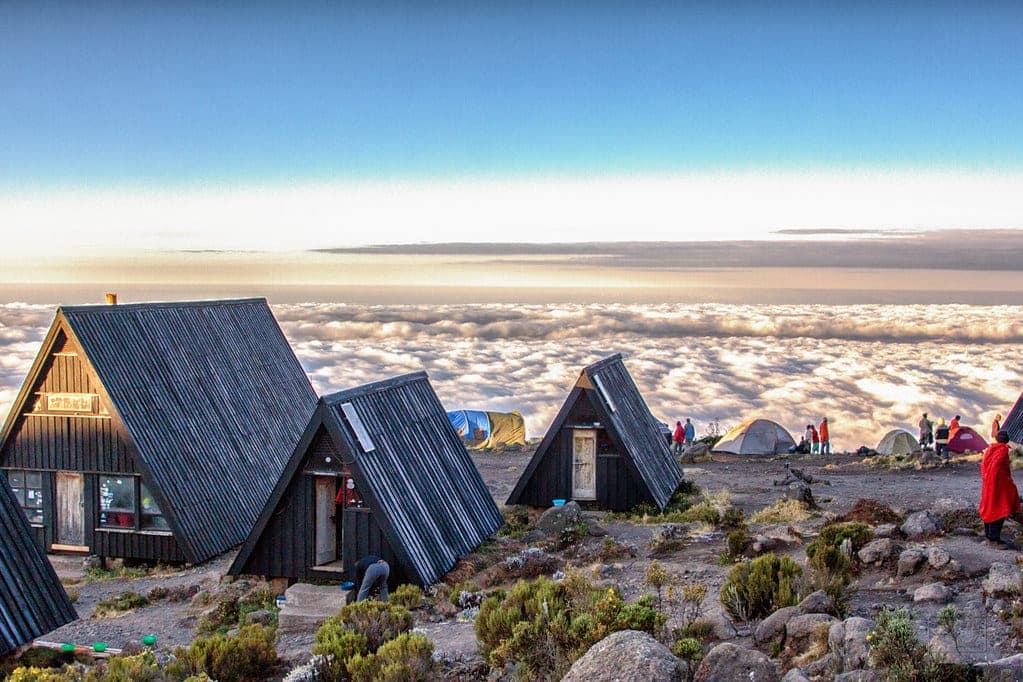
Every other classic route up Kilimanjaro is a camping trip. The Marangu Route — the mountain's oldest trail, in use since the 1900s — is the exception: you sleep in huts at Mandara, Horombo and Kibo, with bunks, mattresses, solar light and communal dining rooms. For trekkers who dread wet tents, or for climbs in the rainier shoulder months, that is a genuine advantage no other route offers.
The second difference: Marangu goes up and comes down the same trail on the south-eastern flank. You see the scenery twice instead of making a loop — the main aesthetic argument against it — but the path itself is the most gradual on the mountain.
Fees and figures below were accurate at the time of writing. Kilimanjaro National Park revises its tariffs periodically — confirm current numbers with your operator before you budget.
The route, day by day
The 6-day itinerary, which is the one to book:
- Marangu Gate (~1,870 m) → Mandara Hut (~2,700 m). Four to five hours through rainforest; blue monkeys and colobus are common.
- Mandara → Horombo Hut (~3,720 m). Out of the forest into moorland with giant groundsels; the first views of Kibo and the jagged Mawenzi peak.
- Acclimatization day at Horombo. A walk up toward Zebra Rocks or the Mawenzi saddle (~4,300 m), sleeping back low. This is the day the 5-day itinerary deletes — and the reason its summit rates suffer.
- Horombo → Kibo Hut (~4,700 m). Across the lunar "Saddle" between Mawenzi and Kibo. Short afternoon, early night.
- Summit night: Kibo Hut → Gilman's Point (~5,681 m) → Uhuru Peak (5,895 m) → Horombo. Away by midnight, five to seven hours of scree switchbacks to the crater rim, then roughly 90 minutes along the rim to Uhuru for sunrise. The same day descends all the way to Horombo.
- Horombo → Marangu Gate. A long, knee-testing descent; certificates at the gate.
The honest assessment
Marangu's "easiest route" reputation needs unpacking. The walking is genuinely the gentlest, and the huts remove real discomfort. But the standard 5-day version reaches 4,700 m faster than any other classic itinerary, and altitude — not terrain — is what stops people on Kilimanjaro. Summit-rate figures quoted by operators put 5-day Marangu at the bottom of the table, often below 50%, against roughly 90% for 8-day Lemosho.
The fix is cheap: the 6-day version's Horombo acclimatization day. If your budget only stretches to five days on the mountain, you will likely be better served by rethinking the trip than by rolling the dice on the short itinerary.
One more Marangu-specific note: hut capacity is fixed, so the route can genuinely sell out on peak dates in a way camping routes don't. Book early for January–February and July–September.
Costs
Marangu is usually the cheapest classic route: one or two fewer days of park fees than Lemosho, and hut accommodation in place of a full camping setup. Realistic supported 6-day climbs start around US$1,600–2,000. As on every route, quotes well below the floor usually mean squeezed crew wages or food. Budget tips on top (customary guidance is around US$200–300 per climber for a 6-day climb), plus flights, visa, and insurance that explicitly covers trekking to 6,000 m.
For a live example with dates and current pricing, the Mt. Kilimanjaro Climbing: 6 Days Marangu Route currently listed on Adventure Knit runs the 6-day itinerary above — Mandara, Horombo and Kibo Huts included — with a professional mountain crew.
Marangu or one of the others?
- Marangu — huts, the gentlest gradients, lowest cost; weakest acclimatization on the 5-day version and an out-and-back trail.
- Machame — camping, more dramatic scenery, a much better acclimatization saw-tooth; the best-value all-rounder.
- Lemosho — the quiet western start and the highest summit rates, at a slightly higher price.
The three are compared side by side in Kilimanjaro's routes compared. Everything currently bookable in Tanzania is on the Tanzania tours page, and companion guides live on our Tanzania hub.
The practical checklist
- Book 6 days, not 5 — the Horombo acclimatization day is the whole game.
- Reserve early for peak season; hut bunks are finite.
- Bring a proper cold-rated sleeping bag — huts are unheated and Kibo Hut sits at 4,700 m.
- Earplugs: dormitory sleeping the night before a midnight summit start.
- Confirm the quote covers park and hut fees, transfers, meals and crew wages, and check current tariffs with your operator.
Frequently Asked Questions
Its walking is the gentlest and its huts remove the camping element, but 'easiest' is misleading: the 5-day itinerary reaches the summit faster than any other classic route, giving your body the least time to adapt, and its summit rates are the lowest on the mountain as a result. The 6-day version with an acclimatization day at Horombo is the sensible way to walk it.
Mandara (~2,700 m) and Horombo (~3,720 m) are clusters of A-frame huts with bunk beds, mattresses and pillows, solar lighting and communal dining halls; Kibo Hut (~4,700 m) is a stone blockhouse with dormitory rooms. You need a sleeping bag but no tent or sleeping mat. Bunks are allocated, and the huts hold the route's capacity, so peak dates genuinely sell out.
Six. The extra night at Horombo — usually spent walking up to Zebra Rocks or Mawenzi ridge and sleeping back at the hut — is a classic climb-high-sleep-low day, and it makes a material difference to summit chances. Five-day Marangu climbs exist because they are the cheapest way up the mountain, not the most likely to succeed.
Marangu is usually Kilimanjaro's cheapest classic route: fewer days of park fees and hut accommodation instead of full camping crews. Realistic supported 6-day climbs start around US$1,600-2,000. Hut fees replace camping fees in the park's tariff, and all fees change periodically — confirm current pricing with your operator.
In the early trekking days the huts along the trail sold soft drinks — Coca-Cola included — while the harder Machame trail earned the 'Whiskey Route' nickname by contrast. The label stuck as shorthand for Marangu being the comfortable, classic way up.
You wake around 23:00, leave by midnight, and switchback up scree to Gilman's Point on the crater rim (~5,681 m) for five to seven hours, then follow the rim roughly 90 minutes to Uhuru Peak for sunrise. It is the coldest, hardest stretch of the route, and the descent the same day drops you all the way back to Horombo.
Adventure Knit Editorial
Destination research compiled and fact-checked by the Adventure Knit editorial team from published sources, operator itineraries, and official tourism boards. Spot something out of date? Tell us at hello@adventureknit.com.
Related Stories
 Tanzania
Kilimanjaro's Lemosho Route: The Quiet Way to the Roof of Africa
A practical guide to Kilimanjaro's Lemosho Route: the 8-day itinerary, the Shira Plateau crossing, why its summit rates are the highest of the classic routes, costs and packing.
 Tanzania
Climbing Kilimanjaro via the Machame Route: The Whiskey Route Explained
A practical guide to Kilimanjaro's Machame Route: the day-by-day profile, why 7 days beats 6, the Barranco Wall, costs, packing, and how it compares to Marangu and Lemosho.
 Tanzania
Kilimanjaro Routes Compared: Machame vs Marangu vs Lemosho
Machame, Marangu or Lemosho? A side-by-side comparison of Kilimanjaro's three classic routes: days, summit rates, accommodation, crowds and cost — and which climber each one suits.
Enjoyed this article?
Explore more stories from our adventures around the world