
The Panorama Route: South Africa's Great Escarpment Drive, Stop by Stop
Categories
Tags
The Panorama Route is a scenic drive along the Drakensberg escarpment in Mpumalanga, South Africa, built around the Blyde River Canyon — one of the largest canyons on Earth and among the greenest. The essential stops are God's Window, the Three Rondavels viewpoint, Bourke's Luck Potholes, and the waterfalls around Graskop and Sabie. A focused day covers the highlights; it sits directly on the road between Johannesburg (4-5 hours) and Kruger National Park's southern gates, which is why most safaris route through it. Dry winter months (May-September) give the clearest views.
Why this drive is on every Kruger itinerary
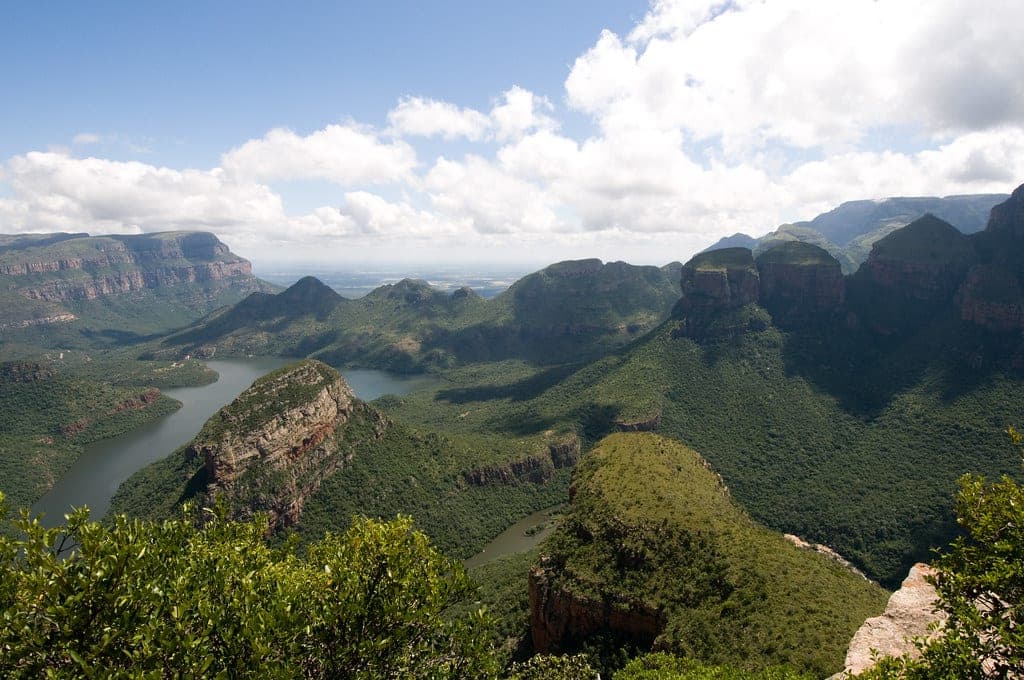
Between Johannesburg and Kruger National Park, the road climbs onto the edge of the Drakensberg escarpment — and for about 70 km the map fills with viewpoints. This is the Panorama Route: the rim of Blyde River Canyon, one of the largest canyons on Earth and among the greenest, where the highveld drops 700–1,000 m to the Lowveld savannah in a single view.
It is not a detour so much as the scenic version of the way you were going anyway, which is why nearly every road safari to Kruger routes through it.
The stops that matter
God's Window. A short walk from the car park to a railed ledge where the escarpment falls more than 700 m to the Lowveld; on a clear day the view runs toward Kruger and, in the haze beyond, Mozambique. Go early — by afternoon, cloud regularly pours up the cliff face and closes the show.
The Three Rondavels. The signature image of the canyon: three dolerite-capped peaks shaped like traditional round huts, rising above a bend of the Blyde River reservoir far below. Late-afternoon light is the photographers' pick.
Bourke's Luck Potholes. Where the Treur River meets the Blyde, whirlpools have drilled smooth, interlocking cauldrons into the bedrock over millennia — crossed by footbridges that put you directly above the sculpture. Named for a gold prospector whose claim here brought him, in fact, no luck.
The waterfalls. The escarpment sheds water everywhere: Lisbon Falls (at ~94 m among the highest in the province) and Berlin Falls sit minutes from Graskop; the plantation town of Sabie anchors another cluster including Lone Creek and Mac Mac Falls. Pick two rather than ticking all of them.
Graskop makes the natural base and lunch stop — its silver-mine-turned-viewpoint Graskop Gorge lift and the town's famous pancakes are both legitimately worth the pause.
Timing and season
A focused day from Graskop covers everything above. If you're in transit from Johannesburg (4–5 hours from the escarpment) toward Kruger, a half-day of highlights — God's Window, Bourke's Luck, Three Rondavels — is the standard and satisfying compromise.
Season matters more here than most South African stops: the whole point is visibility. May–September (dry winter) delivers the clear mornings; summer's afternoon storms bring mist that can blank God's Window entirely — though they also feed the waterfalls. Either way, front-load viewpoints into the morning.
Pairing it with Kruger
The route ends within an hour of Kruger's southern and central gates, so the classic itinerary shape is: Johannesburg → Panorama Route viewpoints → into the park by evening → game drives from there.
That is exactly how the 5-Day Safari with Night Drive and Panorama Route Tour currently listed on Adventure Knit runs it: arrival via the Panorama Route, then open-vehicle game drives in Kruger National Park, a boat safari, a ranger-led night drive from a rest camp, with transfers from Johannesburg and park accommodation included. If your time is shorter, the 3-Day Safari with Night Drive skips the escarpment and goes straight to the wildlife.
Companion reading: our Kruger National Park guide and what a Kruger night safari is actually like. Everything currently bookable in the country is on the South Africa tours page, with all guides on the South Africa hub.
Practical notes
- Viewpoint fees: God's Window, Bourke's Luck and the major falls charge modest per-person or per-car entry fees — carry some cash and expect a few small payments through the day.
- Start early. Clear air burns off; tour buses arrive from mid-morning.
- Fuel and food in Graskop or Sabie — stops thin out along the rim itself.
- Respect the railings. The drops are real and the rock is often wet.
- Winter mornings are cold on the escarpment (it sits at ~1,400-1,800 m) even when Kruger below is warm — pack a layer you'll shed by lunch.
Frequently Asked Questions
Four are essential: God's Window (a 700-plus-metre drop over the Lowveld), the Three Rondavels viewpoint over Blyde River Canyon, Bourke's Luck Potholes (sculpted rock cauldrons where the Treur meets the Blyde), and at least one waterfall — Lisbon Falls and Berlin Falls near Graskop are the classics. With more time add Wonder View, the Pinnacle Rock, and the falls around Sabie.
The core loop from Graskop — God's Window, Bourke's Luck Potholes, Three Rondavels and a waterfall or two — is a comfortable single day. Travellers en route between Johannesburg and Kruger often drive it as a half-day of highlights; photographers and hikers can fill two.
That claim is repeated everywhere and depends entirely on how you measure canyons. What's safe to say: Blyde River Canyon is about 25 km long and roughly 750-800 m deep on average, ranks among the largest canyons on Earth, and is frequently described as the largest 'green' canyon — its slopes are covered in subtropical vegetation rather than bare rock.
The dry winter months, May to September: the escarpment's famous views depend on clear air, and summer brings afternoon thunderstorms and mist that can close God's Window entirely. Winter mornings are the most reliable window; the falls, on the other hand, carry more water in and after the summer rains.
It is the classic pairing — the route ends within an hour of Kruger's southern and central gates. Most multi-day safaris from Johannesburg drive the Panorama Route's viewpoints on the way in, then spend the remaining days on game drives in the park.
Adventure Knit Editorial
Destination research compiled and fact-checked by the Adventure Knit editorial team from published sources, operator itineraries, and official tourism boards. Spot something out of date? Tell us at hello@adventureknit.com.
Related Stories
 South Africa
Night Safaris in Kruger: What You Actually See After Dark
A practical guide to night drives in Kruger National Park: how the ranger-led drives from rest camps work, the nocturnal animals you can realistically expect, spotlight etiquette, and how to book one into a safari.
 Tanzania
Lake Manyara National Park: Tree-Climbing Lions, Flamingos and the Groundwater Forest
A practical guide to Lake Manyara National Park, Tanzania: the famous tree-climbing lions, flamingo flocks on the soda lake, the groundwater forest, and how a half-day here fits a northern-circuit safari.
 Uganda
Murchison Falls National Park: Where the Nile Explodes Through a Seven-Metre Gap
A practical guide to Murchison Falls National Park, Uganda: the boat cruise to the falls, game drives on the northern bank, the top-of-the-falls hike, Ziwa's rhinos en route, and how it fits a Uganda safari.
Enjoyed this article?
Explore more stories from our adventures around the world