
What a Tanzania Safari Really Costs: Budget to Luxury, Line by Line
Categories
Tags
A Tanzania northern-circuit safari typically costs US$250-350 per person per day for budget camping, US$350-550 for mid-range lodges and tented camps, and US$600+ for luxury — driven mostly by accommodation, because park fees, vehicle, fuel, and crew are similar across tiers. Government park and crater fees alone commonly account for US$70-100+ per person per day and cannot be discounted by any operator. As live reference points, tours currently listed on Adventure Knit run from about US$280 per day for a 4-day budget camping safari to about US$600 per day for an 8-day deluxe lodge circuit.
Where the money actually goes
Sticker shock is the standard first reaction to Tanzania safari quotes, so it's worth seeing the anatomy of a price. For a typical northern-circuit day, an honest operator is paying for:
- Park and conservation fees — entry fees per 24 hours for each park, the Ngorongoro conservation and crater-descent fees, and camping or concession fees. Together these commonly account for US$70–100+ per person per day, are set by the government, change periodically, and cannot be discounted by anyone.
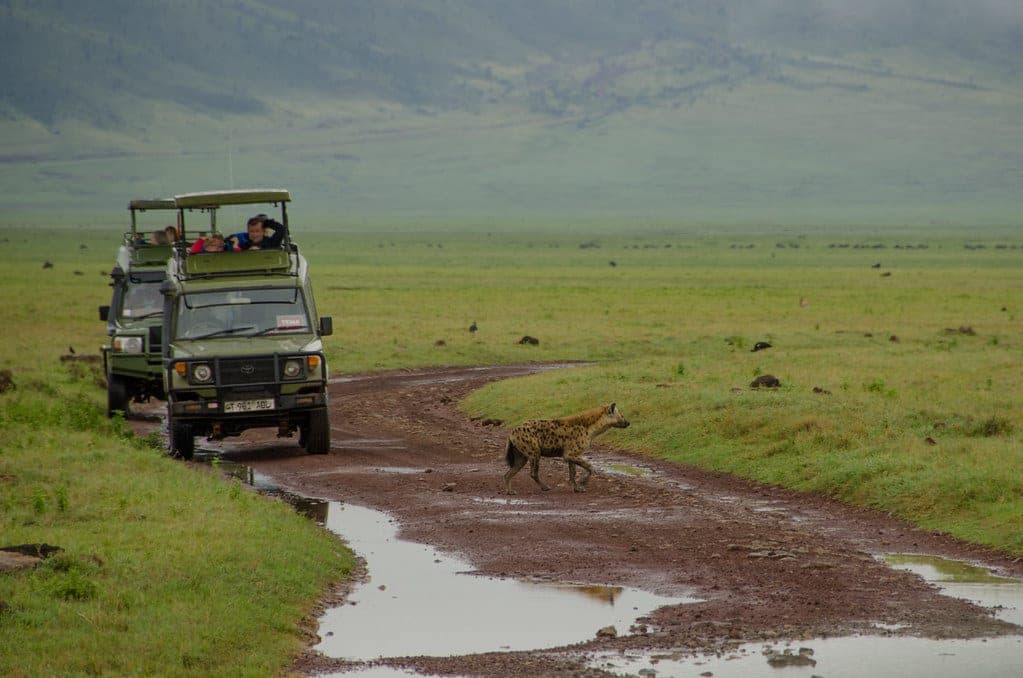
- The vehicle — a Land Cruiser with a pop-up roof, its fuel (distances are long and park tracks are brutal), maintenance, and its driver-guide's wages.
- Board and lodging — the one line that varies wildly, from a public campsite to a US$1,000-a-night lodge.
- Crew and logistics — a cook on camping trips, food purchased and carried, communications, and the office that fixes things when a flight slips.
Accommodation is the multiplier. Everything else is roughly the same whether you sleep in canvas or by a plunge pool — which is why a budget traveller and a luxury traveller can watch the same leopard from adjacent vehicles.
The three tiers, priced
Budget camping — roughly US$250–350 pp/day. Public campsites inside or beside the parks, tents and mattresses provided, crew-cooked meals, usually a shared group vehicle. As a live reference, the 4 Days Budget Safari — Tarangire, Serengeti & Ngorongoro currently listed on Adventure Knit works out to about US$280 per person per day, park fees included, covering three parks in a 4x4 with a professional driver-guide.
Mid-range to premium tented — roughly US$350–600 pp/day. Proper beds, en-suite bathrooms, hot water, either permanent lodges or walk-in tented camps. The 6 Days Tanzania Experience in Luxury Tented Camp sits at this tier's upper end (about US$615/day), running all four northern-circuit parks from premium canvas.
Luxury lodges — US$600 and up. Prime locations, small-group or private vehicles, and lodge service that follows you through the circuit. The 8 Days Deluxe Lodge Safaris: A Tanzania Northern Circuit is a live example at about US$605/day with private vehicles and lodge stays throughout — the entry point of a tier that climbs steeply from there.
Prices above are per person on the listings' current departure dates; each listing shows exactly what is included.
How to read a quote (and spot a bad one)
- Are park fees itemised or "included"? Either is fine — but a total that couldn't possibly contain US$300+ of fees for a 4-day trip is a red flag, not a bargain.
- What vehicle, and shared with how many? Six window seats in a Land Cruiser is standard; more people than windows is not.
- Where exactly do you sleep each night? "Lodge near Serengeti" can mean an hour outside the gate — which converts to two hours of daily game-drive time lost.
- Is the driver-guide's wage sustainable? Rock-bottom quotes are usually balanced on crew pay. Tips are customary either way (US$10–20 per traveller per day is standard guidance), but they should top up a fair wage, not substitute for one.
- What's excluded? Flights, visa (US$50–100 for most nationalities), insurance, drinks, and extras like Serengeti balloon flights (typically US$500+).
Ways to genuinely spend less
- Travel in the green season (November–March outside the holidays, or April–May if you'll accept rain): accommodation discounts are real, and January–February brings the calving spectacle at shoulder-season crowds.
- Join a group departure instead of a private trip — the vehicle and guide are the biggest shareable costs.
- Cut a park, not the acclimatisation of the itinerary — four well-paced days beat six rushed ones. See how the circuit fits together for what each park deserves.
- Book direct with the operator running the vehicle, so no reseller layer sits in the price.
Everything currently bookable in the country — including the three trips above and the Kilimanjaro climbs — is on the Tanzania tours page, with all companion guides on our Tanzania hub.
Figures in this guide were accurate at the time of writing. Park tariffs and operator pricing change; the tour listings above always show current prices and dates.
Frequently Asked Questions
Rules of thumb at the time of writing: budget camping about US$250-350 per person per day; mid-range lodges and tented camps about US$350-550; luxury from US$600 up, with top-end camps far beyond. Solo travellers pay more per head because vehicle and guide costs aren't shared.
Because most of the price is cost, not margin: government park, crater and camping fees (a large, fixed, non-discountable share), a 4x4 with fuel on punishing roads, a professional driver-guide, and full-board logistics in remote places. Conservation fees are also how the parks are funded — it is the model that keeps the Serengeti the Serengeti.
A group camping safari in the June-October or January-February windows booked directly with a local operator: shared vehicle, public campsites, crew cooking. Around US$1,100-1,400 for four days covering Tarangire, Serengeti and Ngorongoro is a realistic honest floor. Cheaper quotes usually mean missing park fees, squeezed crew wages, or a vehicle you'll regret.
International flights, a Tanzania visa (US$50-100 depending on nationality), travel insurance, tips (customary guidance is roughly US$10-20 per traveller per day for the crew), drinks, and a hotel night in Arusha either side of the trip. Balloon safaris over the Serengeti are a separate splurge, typically upward of US$500 per person.
Yes — you drive the same tracks and see the same lions as guests paying five times more; the savings are entirely in where you sleep and eat. The trade-offs are public campsites (shared ablutions, occasional wildlife noise at night) and group departure schedules. For wildlife-per-dollar it is the best deal in Africa.
Adventure Knit Editorial
Destination research compiled and fact-checked by the Adventure Knit editorial team from published sources, operator itineraries, and official tourism boards. Spot something out of date? Tell us at hello@adventureknit.com.
Related Stories
 Tanzania
Tanzania's Northern Circuit: How to Plan the Classic Safari Loop
The Tanzania Northern Circuit explained: how Tarangire, Lake Manyara, Serengeti and Ngorongoro fit together, how many days each deserves, lodge vs tented camp vs budget camping, and sample itineraries.
 Uganda
Planning a Uganda Gorilla and Chimp Safari: Permits, Seasons and Real Costs
How to plan a Uganda safari that combines mountain gorillas in Bwindi with chimpanzees in Kibale: what permits cost, when to go, how long it takes, and what a realistic budget looks like.
 Tanzania
Lake Manyara National Park: Tree-Climbing Lions, Flamingos and the Groundwater Forest
A practical guide to Lake Manyara National Park, Tanzania: the famous tree-climbing lions, flamingo flocks on the soda lake, the groundwater forest, and how a half-day here fits a northern-circuit safari.
Enjoyed this article?
Explore more stories from our adventures around the world